Clear, medically grounded answers about Transcranial Magnetic Stimulation, session routines, safety, and medical aid funding in South Africa.
Self-Assessment Tool
Are You a Candidate for TMS Therapy?
Take this confidential 5-question clinical self-assessment to discover whether Transcranial Magnetic Stimulation is appropriate for your symptoms.
Step 1 of 5
What primary condition is significantly impacting your life?
Major Depression / Persistent Depressive Mood
Severe Generalized Anxiety or Panic Disorder
Obsessive-Compulsive Disorder (Intrusive Loops)
Chronic Neuropathic Pain, Fibromyalgia, or Tinnitus
Step 2 of 5
What has been your experience with psychiatric medications?
Tried 2 or more medications without adequate clinical relief
Experienced intolerable side effects (weight gain, fatigue, emotional blunting)
Seeking an evidence-based, medication-free first-line alternative
Step 3 of 5
Are you seeking a treatment that preserves full mental alertness?
Yes, I need to drive myself and return to work immediately each day
Yes, I want to avoid electroconvulsive therapy (ECT) memory risks
Step 4 of 5
Do you have any metallic or electronic implants in or near your head?
No metallic implants near head (dental fillings and braces are completely safe)
Yes (aneurysm clips, cochlear implant, deep brain stimulator)
Step 5 of 5
Are you able to attend daily 20-30 minute outpatient sessions in Berea, Durban?
Yes, I can attend daily Monday through Friday for 4 to 6 weeks
I would like to discuss flexible scheduling during a consultation
Strong Candidate for TMS Therapy
Based on your responses, you appear to meet the clinical criteria for Transcranial Magnetic Stimulation. We invite you to schedule a comprehensive clinical evaluation with Dr. Suntheren Pillay.
Everything you need to know regarding session structure, safety, medical aid funding in South Africa, and clinical expectations.
A standard acute clinical course comprises 30 to 36 sessions, delivered once daily, five days per week (Monday through Friday) over 6 weeks. Some patients report feeling initial improvements in mood, sleep, or energy within the first two weeks, while others experience the most profound transformation toward the completion of the protocol.
Unlike psychiatric medications, TMS has no systemic side effects — meaning zero weight gain, no sexual dysfunction, no gastrointestinal upset, no nausea, and no sedation. The most commonly reported side effect is a mild, transient scalp tenderness or mild headache during the first few sessions, which typically dissipates quickly or responds to over-the-counter paracetamol.
While ECT remains an inpatient psychiatric intervention requiring general anaesthesia, muscle paralysis, and an induced generalized seizure, TMS is completely non-invasive and outpatient. TMS uses gentle magnetic pulses focused solely on specific cortical targets. You remain fully awake, experience zero memory loss, and can drive home or return to work immediately following treatment.
Yes. South African medical schemes — including Discovery Health, GEMS, Medscheme, Bonitas, and Momentum — increasingly recognize the clinical validity and cost-effectiveness of TMS. Most schemes review applications submitted with a formal clinical motivation from our medical director confirming treatment resistance. Our administrative team assists patients closely through this pre-authorization process.
You may self-refer or be referred by your general practitioner, psychiatrist, or clinical psychologist. If you self-refer, our Medical Director Dr. Suntheren Pillay conducts a comprehensive clinical evaluation at UPPS Wellness to confirm your diagnosis, establish motor thresholds, and map your treatment plan.
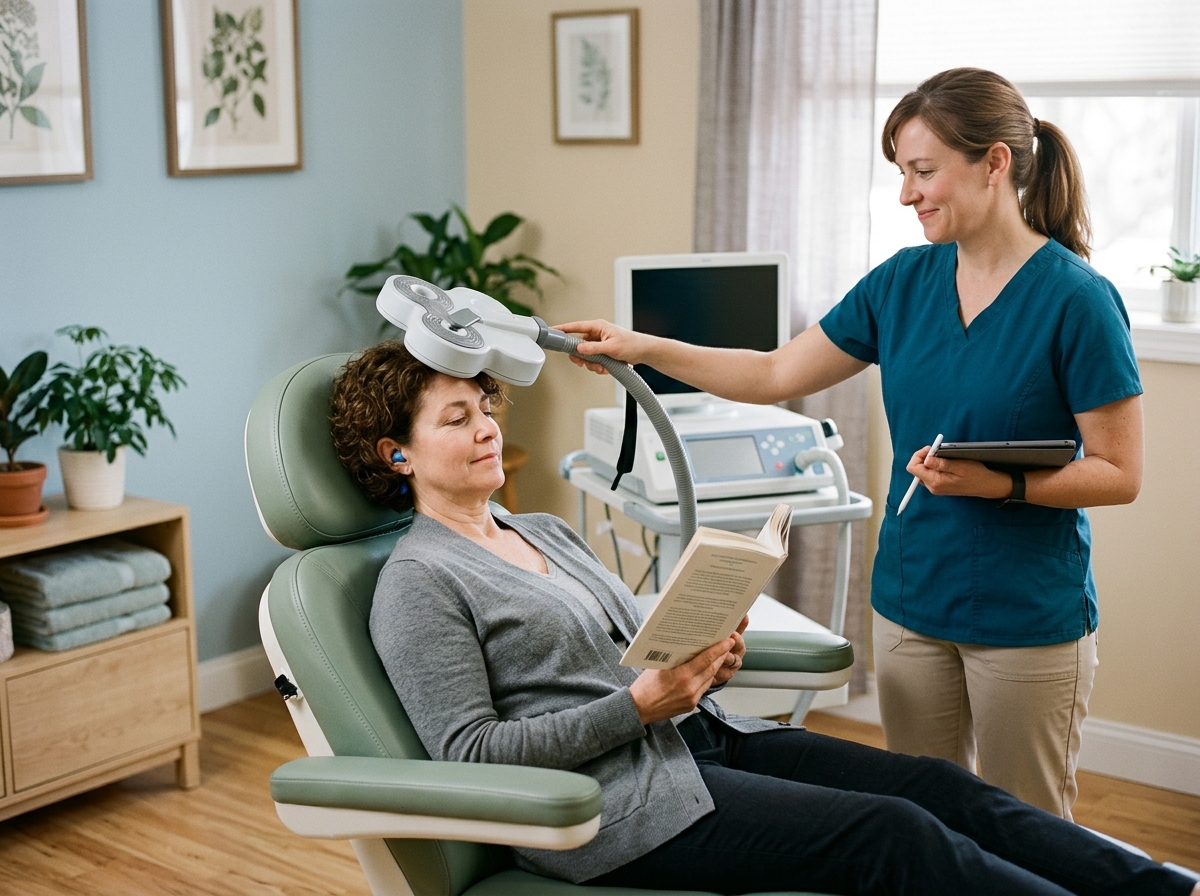
During the session, you will recline comfortably in an ergonomic medical armchair. The treatment coil rests gently against your scalp. When the pulses activate, you will hear a rapid clicking sound (earplugs are provided) and feel a tapping sensation on your scalp, often compared to the gentle tapping of a woodpecker or fingernail. It is not painful, and you can converse, read, or listen to music throughout.
TMS cannot be safely performed if you have non-removable magnetic or electronic metal implants situated within 30cm of the coil (such as metallic aneurysm clips, cochlear implants, or deep brain stimulators). Dental fillings, dental implants, braces, and orthopedic metal implants below the neck are completely safe.
Clinical studies demonstrate that the majority of patients maintain their clinical improvement for 12 months or longer after completing a course. Because TMS promotes long-term synaptic neuroplasticity, the brain learns to sustain healthy rhythmic communication. Maintenance or booster sessions are available if symptoms ever re-emerge during stressful life periods.
Have a Question Not Answered Here?
Our clinical administration team in Berea is available to discuss your specific medical aid or treatment queries.